 Rings and stains
Marble stain removal
Poultices for scale rings, rust around drains and cosmetic stains.

Shower trays, cladding and basins freed from limescale, honed, polished and sealed against humidity.
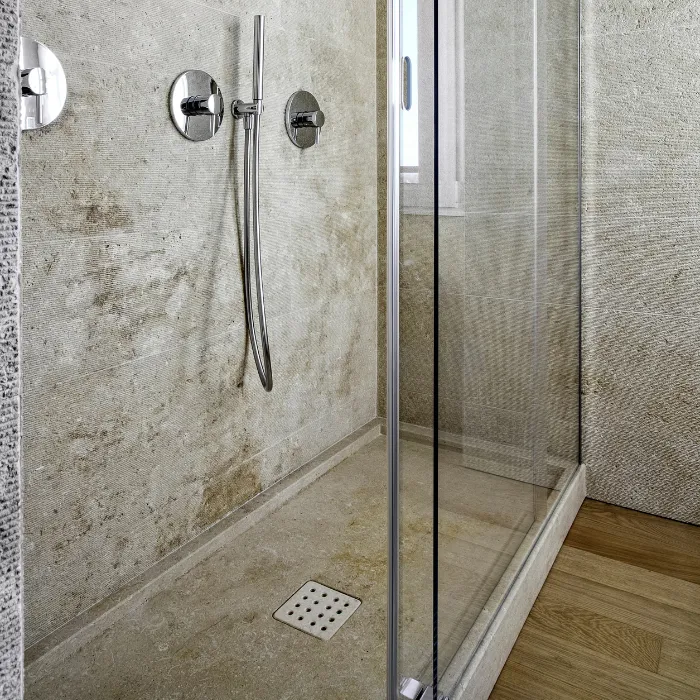
Most requests for marble bathroom restoration in Milan begin with something you notice every morning: a shower tray that has lost its sheen, a chalky haze around the taps, a basin with rings that no sponge will shift. No room in the home puts stone under more pressure. Hot water, steam, soaps, cosmetics and cleaning products all play their part, but the real culprit is limescale, which builds up in Milan far faster than newcomers to the city expect.
We restore shower trays, wall cladding, vanity tops, clad baths, thresholds and floors. The aim is straightforward: bring the stone back to its original finish, remove deposits and acid damage, then protect it so the bathroom stays beautiful for longer. We work on the marble itself, with no coatings or films that would peel away in the humidity.
After a visit, or simply after seeing a few photos sent over WhatsApp, we put forward a tailored plan and a free written quote.
Milan draws its tap water from aquifers beneath the Po plain, and it carries plenty of calcium and magnesium. It is perfectly good to drink, yet every drop that dries on a surface leaves behind a thin film of carbonate. Over weeks, that film thickens on shower walls, basin rims and around drains. On glazed ceramic, an ordinary cleaner deals with it. On marble, things are trickier, because the deposit and the stone are chemically almost the same thing.
That is where the most common damage we see comes from. To shift the build-up, people reach for supermarket descalers, which rely on citric, formic, phosphoric or even dilute hydrochloric acid. These dissolve limescale, and they dissolve marble just as readily. The result is etching: dull, rough patches and pale streaks that trace the spray pattern or the runs down the wall. The more descaler is used, the more porous the surface becomes, and the faster it collects fresh scale and dirt.
Restoration breaks the cycle. We lift the deposits mechanically, remove the etched layer with water-cooled diamond abrasives, rebuild the finish and apply a protective treatment that makes routine cleaning far easier, so acidic products are no longer needed.
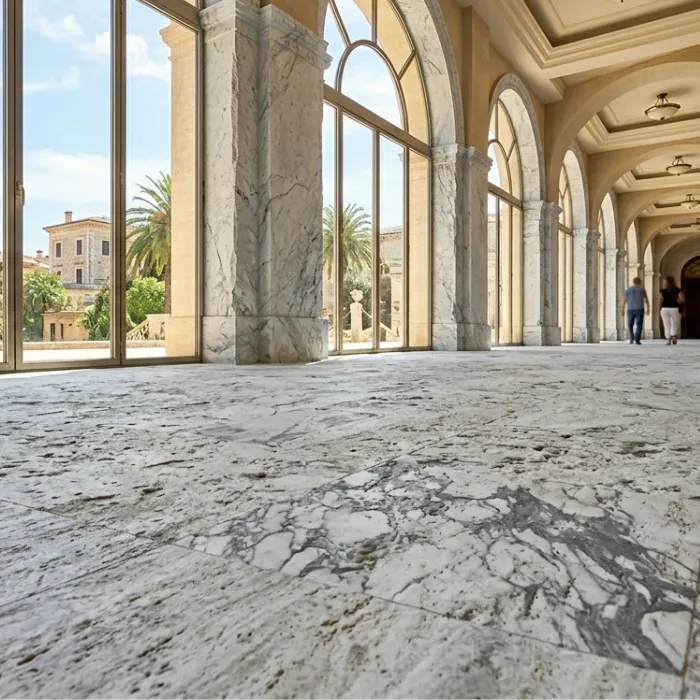
A marble bathroom never ages evenly. Each element has its own weak spot, and each calls for its own technique.
Standing water, soap and wet feet: the floor of the shower turns rough and dull, and the drain surround cakes over. We remove the damaged layer and usually recommend a honed finish, which grips better underfoot.
Vertical runs of descaler, dried droplet marks and dye from coloured shampoos. We work the panels with light machines and hand tools until the surface is even from floor to ceiling.
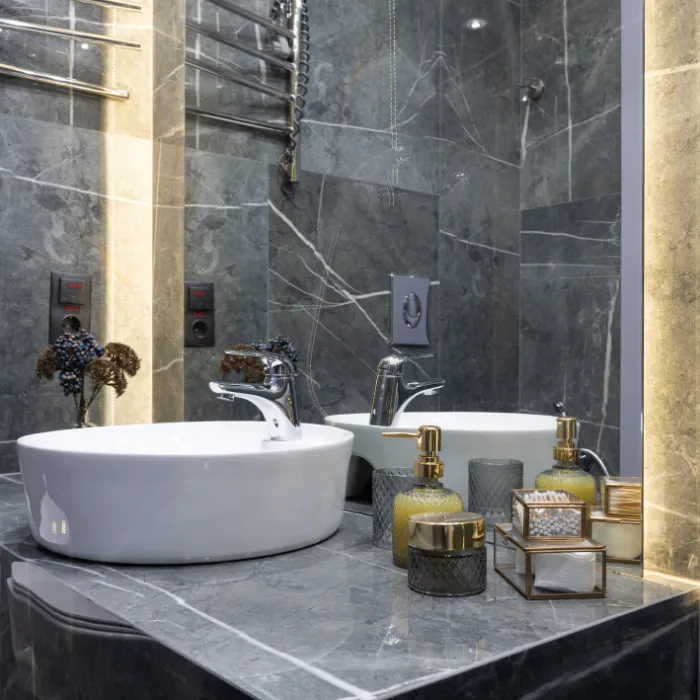
Perfume, toothpaste, mouthwash and cosmetics can be acidic or strongly coloured, and white rings form around the mixer. We restore the top and carved basins, inside curves included.
Blackened grout, yellowed silicone and hairline gaps that let water in. We deep-clean or redo the joints in a colour matched to the stone.
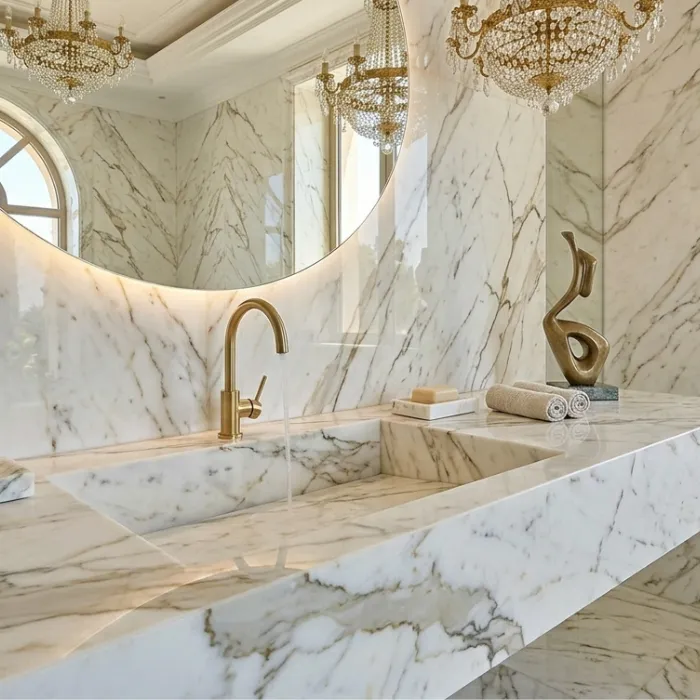
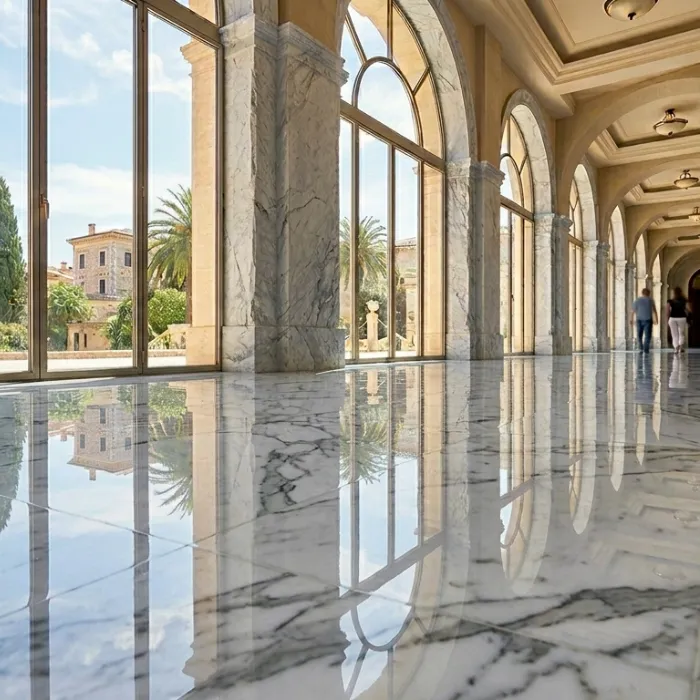
In a bathroom, the finish is about more than looks. Walls and vanity tops can take a full polish that brings out the veining of Calacatta or Bardiglio and catches the light from the mirror. Shower trays and floors, walked on with wet feet, are better served by a honed or satin finish that is less slippery and less prone to showing faint scale marks.
Several finishes can sit side by side in the same room while keeping the original design coherent. We always try the result on a discreet area first, so you can judge it for yourself before we carry on.
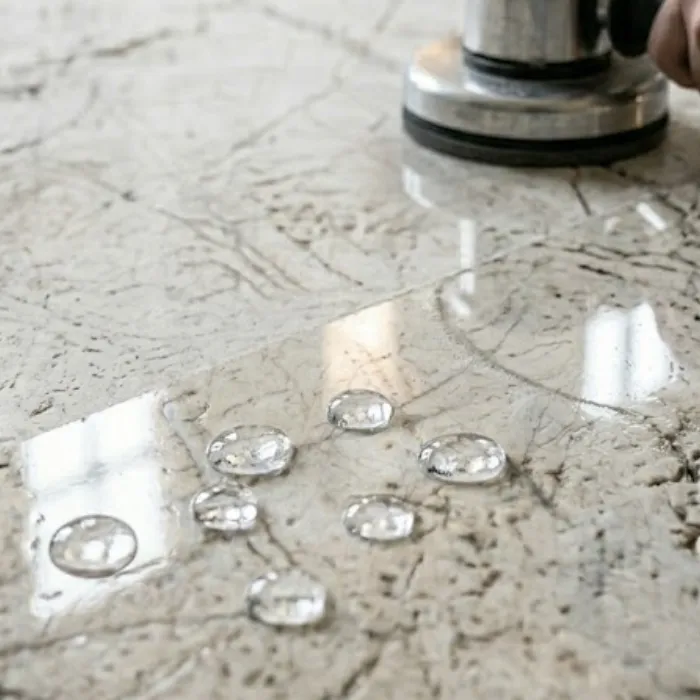
Once restored, the stone receives a breathable impregnator that soaks into the pores without leaving a film on top. Water and soap run off more easily, scale settles less and wipes away, and steam cannot cause bubbling or peeling.
We identify the marble, tell surface scale apart from genuine etching and check the joints.
Sanitaryware, taps, furniture and mirrors are covered, and the hallway is protected, since we work wet.
Deposits come off first, then the etched layer is removed with a diamond sequence suited to each surface.
Polishing or satin finishing, regrouting and chip repairs.
We apply the impregnator, allow it to cure and explain when the shower can be used again.
The single most useful habit costs nothing: after each shower, run a squeegee over the walls and tray, then a dry microfibre cloth. Water that never evaporates cannot leave scale behind.
For a weekly clean, warm water and a pH-neutral cleaner made for natural stone are all you need. Keep descalers, vinegar, lemon, bleach, cream cleansers and scouring pads well away, even those labelled gentle. Stand shampoo bottles and soap dispensers on a small tray, as their wet bases leave rings that are hard to remove. Check the sealant once a year and, depending on use, renew the protective treatment. In heavily used bathrooms, such as hotel rooms or rental flats, a scheduled maintenance visit keeps the result looking fresh.
Rings and stainsPoultices for scale rings, rust around drains and cosmetic stains.
 Water repellent
How we choose the right impregnator for a shower, a basin or a floor.
 Chips
Chipped bath edges, fine cracks and colour-matched filling.
Not usually. Scale itself is a deposit sitting on the stone and can be removed. The real harm comes from attempts to dissolve it with acidic products, which etch the surface. Even that etching tends to be shallow and can be honed out, then polished. We test a small area during the visit before you commit to anything.
We work with water, so moisture is not an issue for the stone itself. The sealer, however, needs time to cure inside the pores, so we generally ask you to leave the shower for around twenty-four hours. If joints or silicone have been redone, the wait may be slightly longer, and we will tell you exactly at handover.
A mirror-polished tray covered in soapy water can be. That is why we usually suggest a honed or satin finish for shower floors: it offers more grip while keeping a rich, even colour. Walls and basins can stay polished, and we agree the finish with you during the visit.
It depends on the area of marble, how many elements need work, the depth of etching, any repairs or regrouting, and access to the flat. A small cloakroom and a fully clad master bathroom are very different jobs. After the visit you receive a detailed written quote, free of charge.
Rarely. We work around them, protecting them carefully and using hand tools in tight corners. If a vanity unit hides damaged stone, it may help to have a plumber lift it, and we flag this in the quote so you can plan ahead.
The quickest route is WhatsApp: send a few photos of the tray, walls or basin, ideally in daylight with one wide shot. You can also fill in the quote form with your neighbourhood and a rough size. We will come back to you to arrange a visit at a time that suits you.
Send us a few photos or fill in the form, and we will prepare a tailored plan with a free written quote.