
 Foundation
Marble polishing
The mechanical shine that crystallisation builds on.
A controlled reaction that hardens the surface of calcareous marble and keeps busy floors brighter for longer.
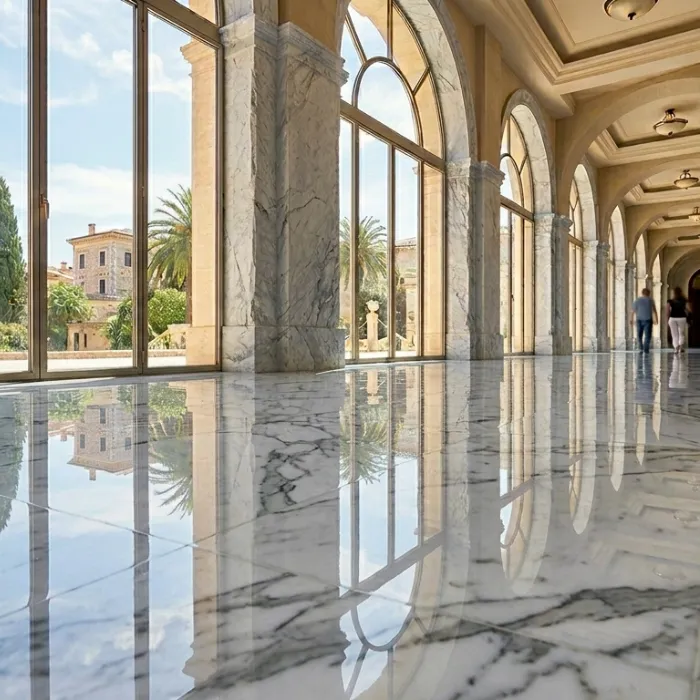
Marble crystallisation in Milan is above all a solution for heavily used floors: the entrance halls of apartment buildings, hotel lobbies, shops, office corridors, and private hallways where daily comings and goings dull a polished finish within months. It is a chemical and mechanical treatment that alters the very top layer of the stone, making it denser, more reflective and better able to resist wear.
The idea is easy to explain and demanding to carry out. A fluorosilicate-based product is spread over the marble and worked in with a single-disc machine fitted with steel wool. The heat from friction drives a reaction with the calcium carbonate, forming an extremely thin layer of calcium fluoride and silica that is harder than the original stone. Nothing is laid on top: it is the marble itself, transformed to a depth of a few microns.
That is why crystallisation does not peel or yellow, and why the stone keeps breathing. It only works on certain stones, though, and on surfaces already in good condition, so we always check before recommending it.
The benefit shows wherever polishing alone would wear through too quickly.
The route from the street door past the post boxes to the lift keeps its shine far longer, even with bikes and trolleys. Entrance halls
Entrances and central aisles cope better with footfall, including the busy weeks around Design Week in April. Boutiques
Homes with children or pets, where grit from outside dulls the floor fast.
The reaction needs calcium carbonate, so our first job is to identify the material with certainty.
Granite, quartzite, Baveno pink granite and the serizzo often found on Lombard thresholds and steps are siliceous stones. With no carbonate present, the product has nothing to react with. On these materials we reach the shine by mechanical polishing alone and protect them with a dedicated impregnator.
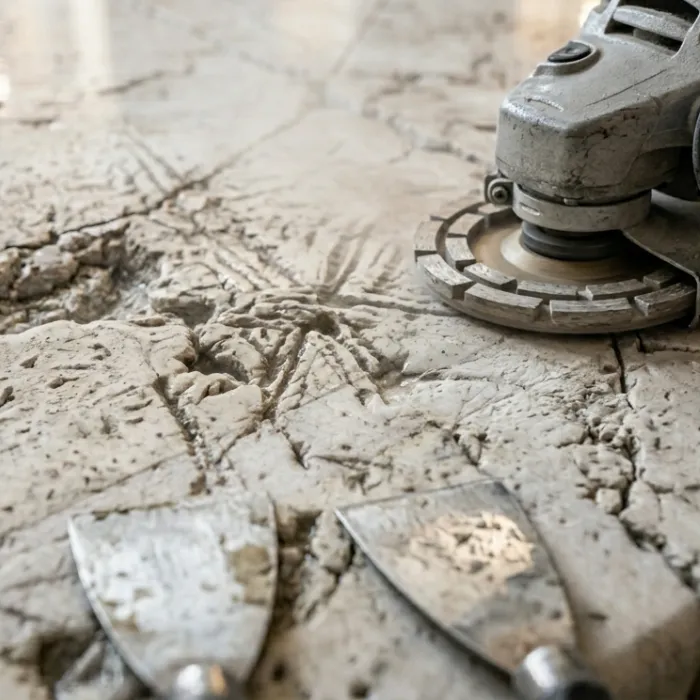
Even on the right marble, crystallisation does not hide defects; it locks them in. On a floor covered in deep scratches, with lips between tiles or dips left by acid, it would simply produce a glossy uneven surface with broken reflections. In those cases we begin with grinding to flatten the stone, then polish, and only then crystallise.
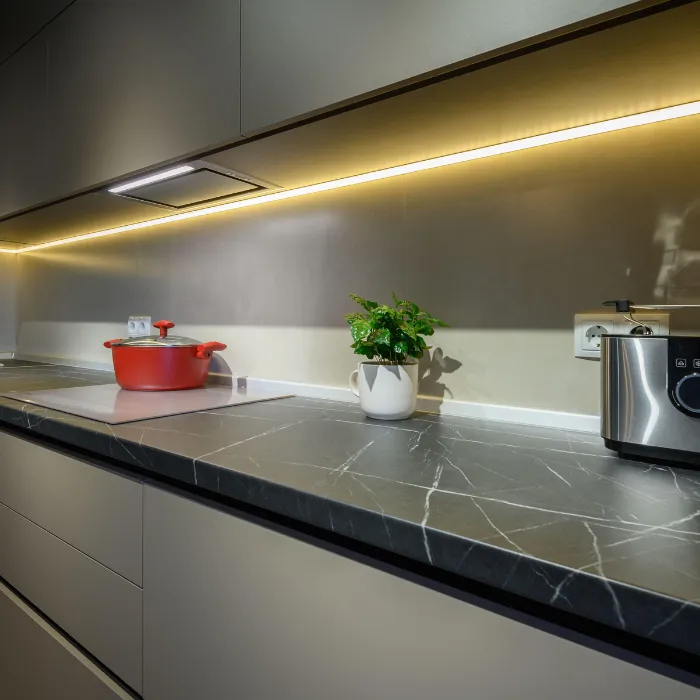
We also steer clear of it on food-preparation surfaces and kitchen worktops, where polishing followed by an oil-repellent sealer works better, and on outdoor marble exposed to frost and rain.
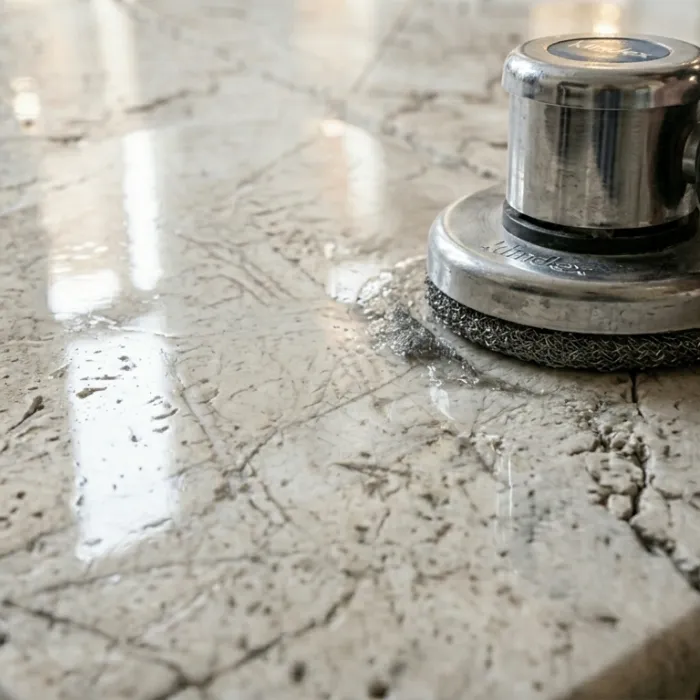
In contact with calcium carbonate, and under the action of steel wool, the fluorosilicate forms harder, less soluble compounds. The surface closes up, reflects more light and stands up better to the micro-scratches of everyday foot traffic.
We work in small sections, using the product sparingly and keeping an eye on surface temperature; too much product or heat would leave white hazing that is hard to remove. The floor is then neutralised and rinsed, and can be walked on straight away.
We confirm it is calcareous and check flatness, scratches and any previous coatings.
Old wax and resin are stripped; deep scratches are ground and polished out first.
The fluorosilicate product is worked in with a single-disc machine and steel wool.
All residue is removed and the floor is ready for use.
Crystallisation is nearly always the final link in a chain of work.
FoundationThe mechanical shine that crystallisation builds on.
 Flatness
Essential where scratches run deep or tiles stand proud.
 Over time
Periodic visits that keep busy areas bright.
No. Nothing is deposited on top of the stone. The product reacts with calcium carbonate and transforms the marble’s own surface to a minimal depth, so it cannot flake, does not yellow and lets the stone breathe. Over time it wears down with use, just as the stone does, and can be renewed without any stripping.
No. Granite and other siliceous stones contain no calcium carbonate, so the product has nothing to react with. On Baveno pink granite, serizzo or quartzite we achieve the shine through mechanical polishing and protect the surface with a dedicated impregnating sealer instead.
We would advise against it. Crystallisation hardens and brightens the surface exactly as it is, scratches included, and on uneven stone the reflection looks broken. The floor should first be ground to remove deep marks and level the tiles, then polished; crystallisation gives its best only after that.
Very briefly. We work in sections and always keep a clear route to the stairs and lift, and treated areas can be walked on once neutralised and dry. Timings and notices to residents are agreed with the building manager in line with the building’s rules.
The area involved, the condition of the stone, whether stripping or grinding is needed first, furniture or obstacles, and access, for instance inside Area C. After the visit you receive a free written quote that lists each stage separately.
Message us on WhatsApp with a few photos of the surface and, if you know it, the type of marble, or fill in the quote request form. We will get back to you promptly to arrange a visit.
Show us the surface with a few photos on WhatsApp or through the form. We will check the stone and send you a free quote.