
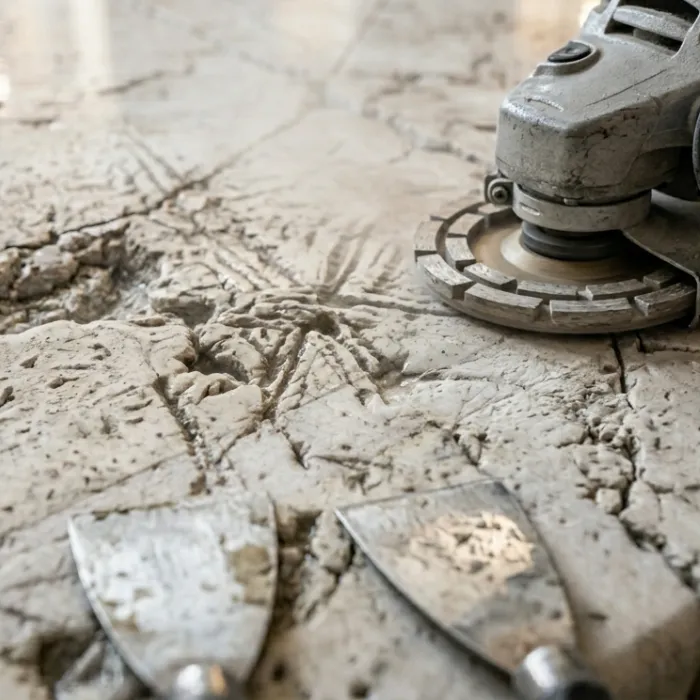
 Flatness
Marble floor grinding
When coarse grinding is needed, how it is done and what it changes for the stone.
Grinding, joint filling and polishing to restore flatness and light to marble floors, from period palazzi to contemporary flats.
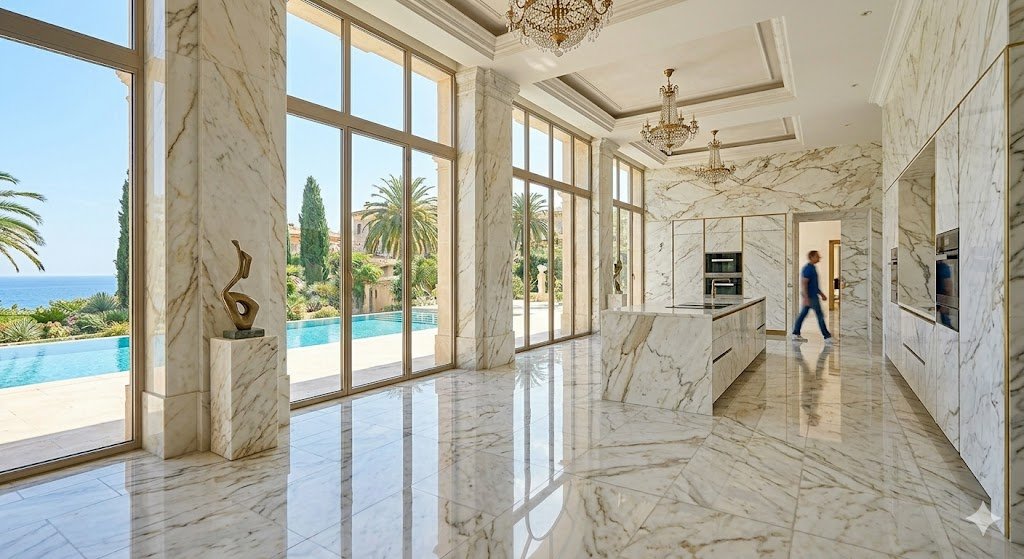
Good marble floor restoration in Milan begins with reading the floor’s history: when it was laid, which stone was used, how often it has been treated and with what. The drawing room of a nineteenth-century palazzo, the hallway of a 1930s flat and a recent open-plan space in Statuario all wear in their own way, so none of them is handled in quite the same manner.
A floor works harder than any other marble surface. It carries furniture, grit from the street, chairs dragged back and forth and the occasional unsuitable cleaner. Over the years it loses flatness, collects fine scratches that kill the reflection and, on older floors, disappears under layers of wax that yellow and hold on to dirt. Our job is to remove everything that is not stone and bring the real marble back into view.
We work in occupied flats, villas, offices and shops, organising the job room by room. After a free visit you receive a written quote that sets out each stage of the work.
From period apartments to recently refurbished homes, these are the defects we come across most often.
Slight height differences from one slab to the next, typical of old floors laid on a screed that has settled. You feel them underfoot and dirt gathers along the edges.
Decades of wax and polish build a yellowish film, dull where people walk and glossy under the furniture, hiding the true colour of the stone.
Crumbling, blackened or empty grout lines let mop water seep in, and the slab edges start to chip.
Worn tracks by the doors, rings left by vases and glasses, etch marks near the kitchen: damage confined to the top layer of the stone.
Milan’s nineteenth and early twentieth-century palazzi mostly have slabs laid in a running bond, or a two-colour chequerboard that often pairs a white Carrara with a grey bardiglio or a black stone. Borders, Greek-key bands and inlaid medallions appear more rarely. Each pattern needs care: grinding without allowing for the different marbles can dish the softer stone and leave the harder one standing proud.
On chequerboards we therefore set pressure, grit and machine speed according to the softer stone, and check flatness regularly with a straightedge. On inlays we switch to smaller machines, and to hand work where needed, so the edges of the design stay crisp. On coloured marbles we make sure the final polish gives every colour the same depth of reflection.
Rationalist buildings and post-war blocks tend to have larger slabs with very tight joints. Here flatness is the main concern: a screed that has moved over the decades may have lifted a few edges by fractions of a millimetre, which is enough to break the reflection and make every joint visible.
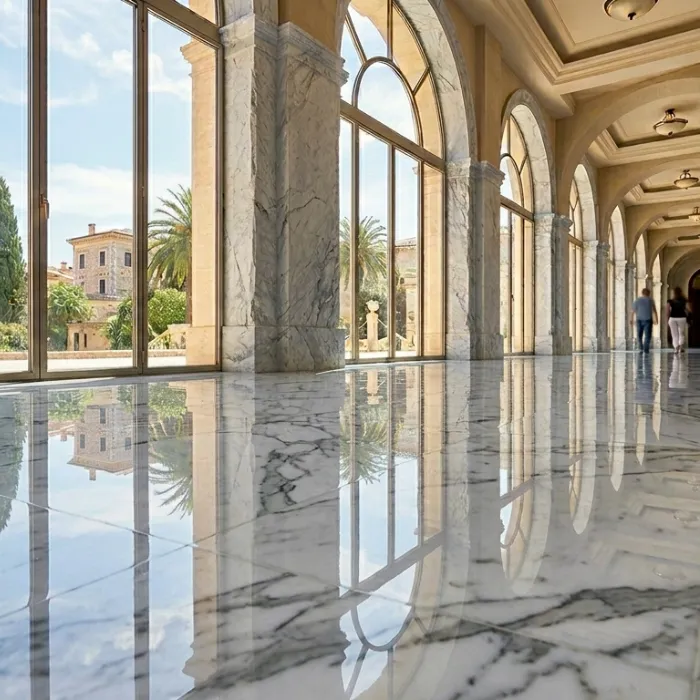
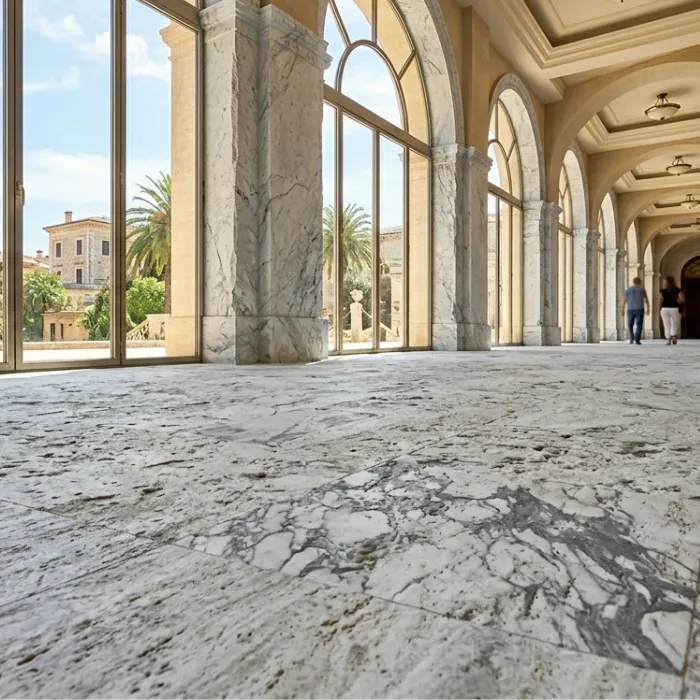
A full restoration rests on three complementary stages. Grinding with coarse diamond abrasives removes lipping, deep scratches and old coatings. Joint filling with resins or tinted fillers matched to the stone closes the gaps and firms up the slab edges. Polishing through progressively finer grits then takes the surface to the level of sheen you choose: mirror gloss, satin or a matt honed finish.
On large floors we split the work by room or by areas bounded by thresholds, so part of the home always stays usable. Our machines run wet, which keeps dust down, but the stone has to dry properly before the final sealer goes on. Depending on the marble’s porosity, the season and ventilation, this usually means anything from one night to a couple of days before sealing and moving the furniture back.
We tell you in advance which rooms will be closed and for how long, so day-to-day life can carry on without surprises.
No. If the floor is flat and only dull or lightly scratched, polishing with medium and fine grits can be enough. Coarse grinding becomes necessary when there is lipping between slabs, deep scratches, heavy etching or old wax that chemicals cannot shift. We decide during the visit with a small trial on site, so no more stone is removed than necessary.
Sometimes, using a dedicated wax stripper and machine scrubbing. On floors waxed for decades, though, the wax has soaked into the pores and joints and a stripper will not reach it. Grinding is then the cleanest answer: it removes the yellowed film and the damaged layer of stone together, leaving a surface ready for polishing.
It depends on the area and the number of passes. A normal-sized room usually takes a day, plus the time for the filler to cure and the stone to dry before sealing. Your quote includes a room-by-room schedule so you can plan around it.
The price depends on the floor area, the condition of the stone, any wax or lipping, the number of joints to fill, the finish you want and site access — the Area C congestion zone or a building without a lift, for example. We do not publish rates: after the visit you receive a free, itemised written quote.
Properly polished marble is no more slippery than new marble, because it is not covered by wax or a film. It becomes slippery mainly when wet or treated with film-forming products. For entrances, kitchens or rooms opening onto a terrace we can suggest a satin or honed finish with better grip.
Send us a WhatsApp message, ideally with a wide shot of the floor and a few close-ups, or fill in the quote request form. We will reply quickly to arrange a visit.
The floor is often where a project starts; staircases, lobbies and bathrooms follow the same logic with different constraints.
FlatnessWhen coarse grinding is needed, how it is done and what it changes for the stone.
ShineFrom satin to mirror gloss: choosing a finish to suit how the room is used.
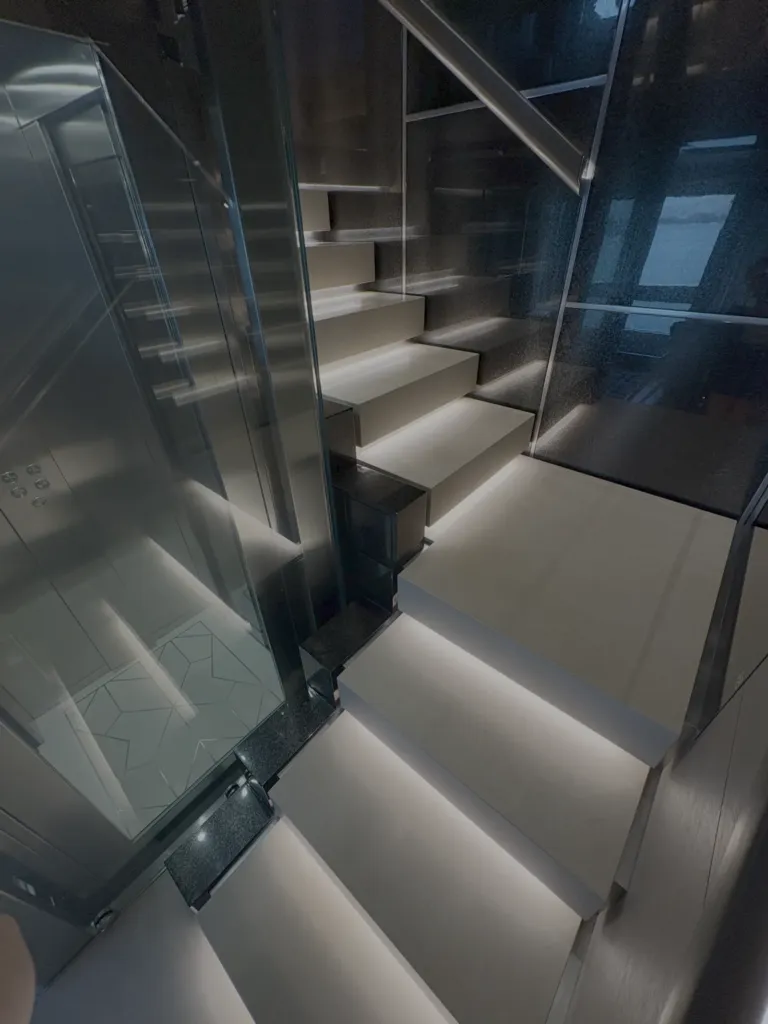 Steps
Worn treads and broken nosings on private and communal staircases.
From Brera to Porta Venezia, Magenta to CityLife, and out to Monza and Lake Como.
Send a few photos on WhatsApp or use the form: we will arrange a visit and prepare a free, detailed quote.