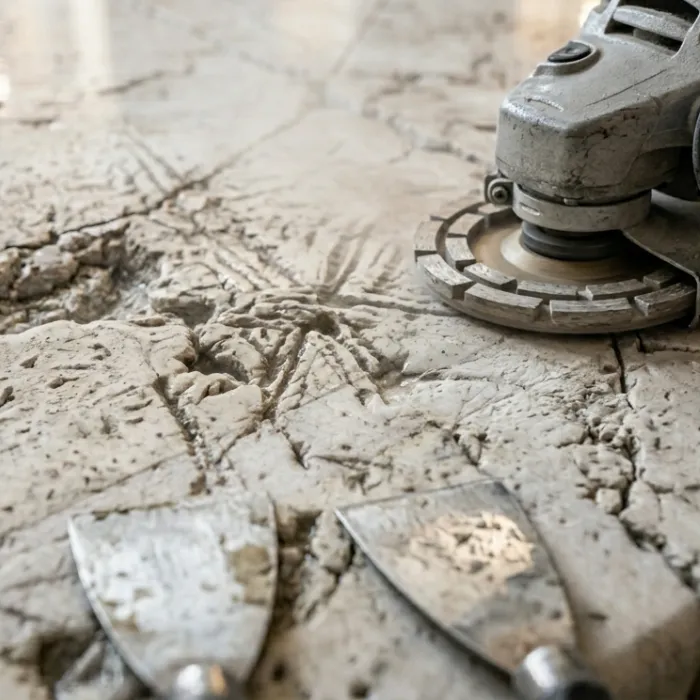
 Before
Marble floor grinding
Levels the tiles and removes deep scratches ahead of polishing.
We bring your marble back to the finish you want, from matt to mirror gloss, by working the stone with diamond abrasives and water.
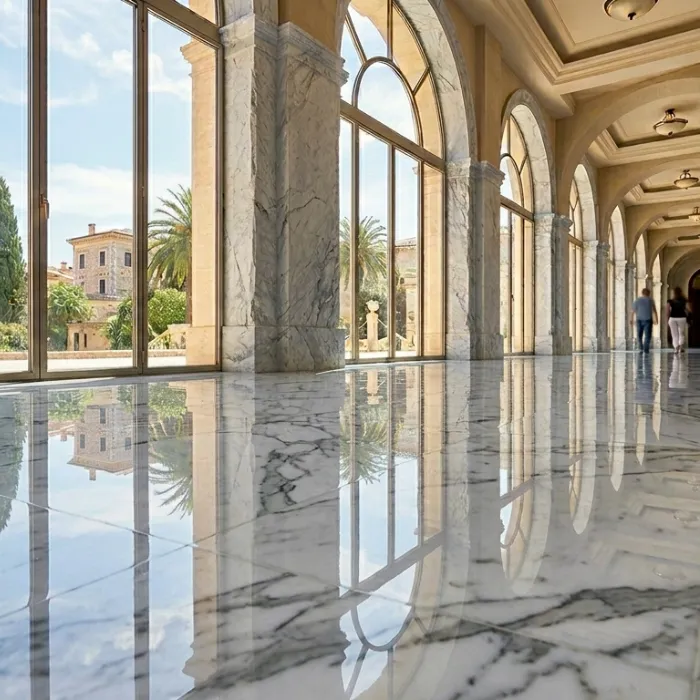
Of all the work we carry out, marble polishing in Milan is what clients ask for most, and it is also the treatment people most often misunderstand. A gleaming floor is usually assumed to be the result of a good wax or a “revitalising” product. In fact, the reflection you see on freshly polished marble comes from the stone: its surface has been made so even, at a microscopic level, that it sends light back like a mirror.
We get there with a sequence of diamond abrasives fitted to single-disc or planetary machines, always working wet. Each pass removes the marks left by the one before, using a finer grit each time, until the surface reaches the look you have chosen: matt, honed, satin or full gloss. There is no wax, no varnish and no film to wear away or turn yellow.
What you are left with is still natural stone in every sense. It breathes, it is easy to clean, and years from now it can be polished again without first stripping away layers of old product.
A full grind is not always necessary. If the floor is flat and the damage sits on the surface, careful polishing does the job in less time and with less disruption.
The finish is set by the last grit used. Each has its own character and behaves differently day to day, so it is worth choosing with the room, the light and the way you live in mind.
Flat and non-reflective, slightly paler in tone. It disguises small signs of wear and suits bathrooms and pared-back interiors.
Smooth to the touch with deeper colour, yet the light stays soft. The traditional finish on many old Lombard floors.
A gentle, silky sheen that brings out the veining without glare. A sensible choice for bright living rooms and busy tabletops.
Full reflection, saturated colour, crisp veining. The most dramatic option, made for entrance halls and lobbies.
Marble is a calcareous stone, made largely of calcium carbonate, and it is fairly soft. The grit carried in on shoes acts like ultra-fine sandpaper, leaving countless tiny scratches that scatter light. That is the dull track you see along corridors, in front of the sofa, or between the street door and the lift in an apartment building.
Acids do the rest. Lemon juice, vinegar, wine and fizzy drinks react with the carbonate and leave cloudy etch marks that no cloth will shift. Milan’s tap water is quite hard, so many households reach for descaling cleaners in the bathroom and kitchen, and these are among the most common causes of dull marble we come across.
Then there are previous treatments. Waxes, home “crystallising” kits and resin-based polishes form a layer that scratches, traps dirt and yellows over time. When we find one, it comes off first: the shine has to be recovered on bare stone.
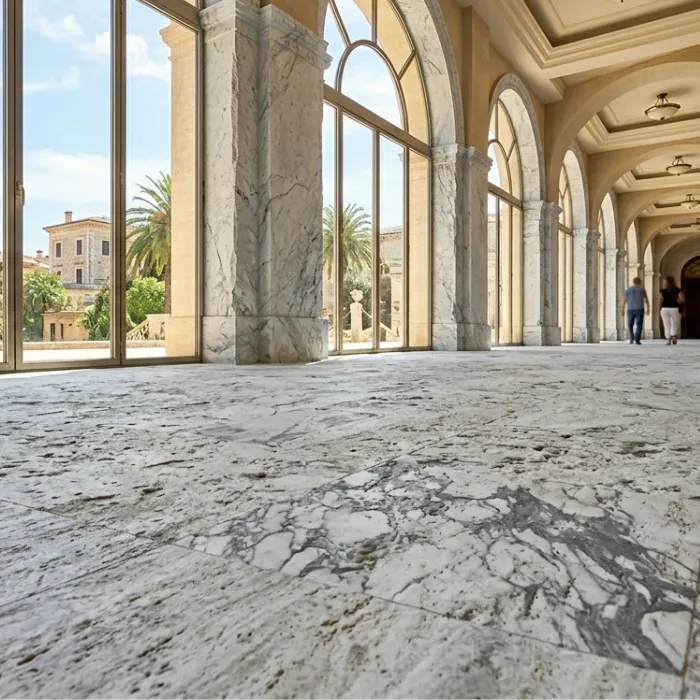
On a discreet corner we check how the stone responds and show you the finish you will get, so you decide on your own marble.
Skirting and fitted furniture are covered, and ingrained dirt or old wax is lifted with stone-safe products.
Successive wet passes with ever finer grits, collecting the slurry and checking the surface under raking light.
The last pass sets the level of sheen. The floor is rinsed and left to dry evenly.
If you wish, we apply a water and oil repellent that forms no film and leaves the finish untouched.
Deep scratches, uneven tiles and heavily used floors call for an extra stage before or after polishing.
BeforeLevels the tiles and removes deep scratches ahead of polishing.
 After
Hardens a polished surface where foot traffic is heaviest.
 Protection
Slows down staining on kitchens, bathrooms and tables.
That depends on traffic and cleaning habits. In a home cleaned with pH-neutral products and kept away from acids, the shine holds for a long time. In a busy building lobby the dull track along the main route returns sooner. A light maintenance visit every so often keeps the result without starting again from scratch.
No. The shine is achieved mechanically, with progressively finer diamond abrasives used wet, so it is the stone that reflects the light. Afterwards we can apply a breathable sealer that forms no film and leaves your chosen finish exactly as it is, but we never use waxes, which scratch and yellow over time.
Of course. Stopping the abrasive sequence at an intermediate grit gives a honed or satin surface with a softer sheen. Before we start, we show you the result on a test area so you can judge it on your own floor, in the real light of the room, rather than from a sample.
It removes cloudy etch marks caused by acids, because it takes away the corroded surface layer. Dark stains absorbed deep into the stone, such as oil, rust or wine left too long, need a dedicated poultice treatment first, otherwise they would still show through the new finish.
The price depends on the floor area, the condition of the surface, any old wax to strip, the finish you want and site access, including the floor level, the lift and where we can unload. After the visit you receive a detailed written quote, free of charge.
Send us a few photos on WhatsApp, ideally taken in daylight and at a low angle against the light, or fill in the quote request form. We will reply quickly and arrange a visit on a day that suits you.
From period flats in Brera to new apartments in CityLife, we plan each job around Area C, lift sizes and building rules.
Send us a few photos on WhatsApp or use the form. We will arrange a visit and prepare a free quote for the finish you have in mind.