
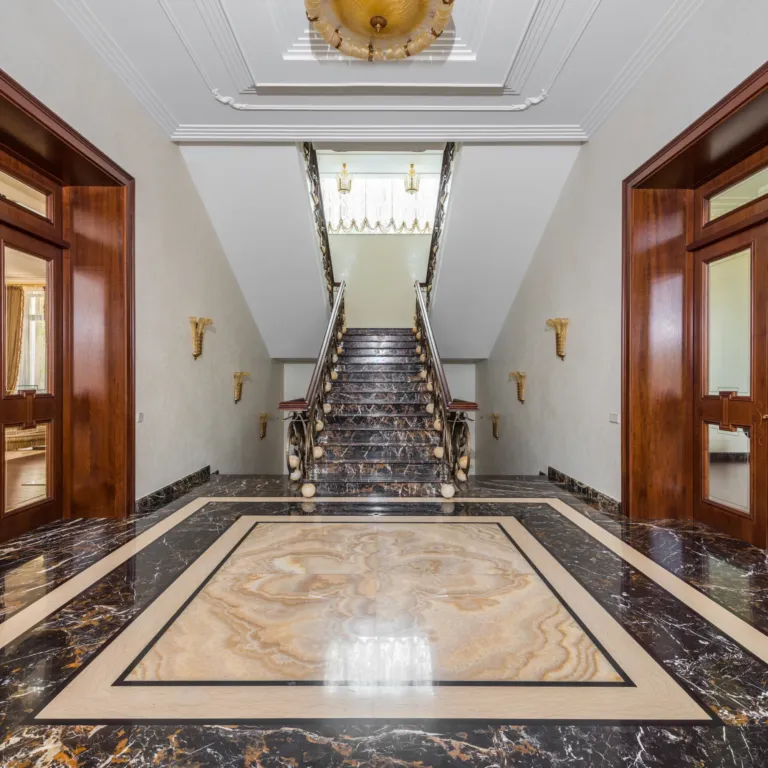
 Apartment buildings
Marble entrance halls
The building lobby, often restored together with the first flight of stairs.
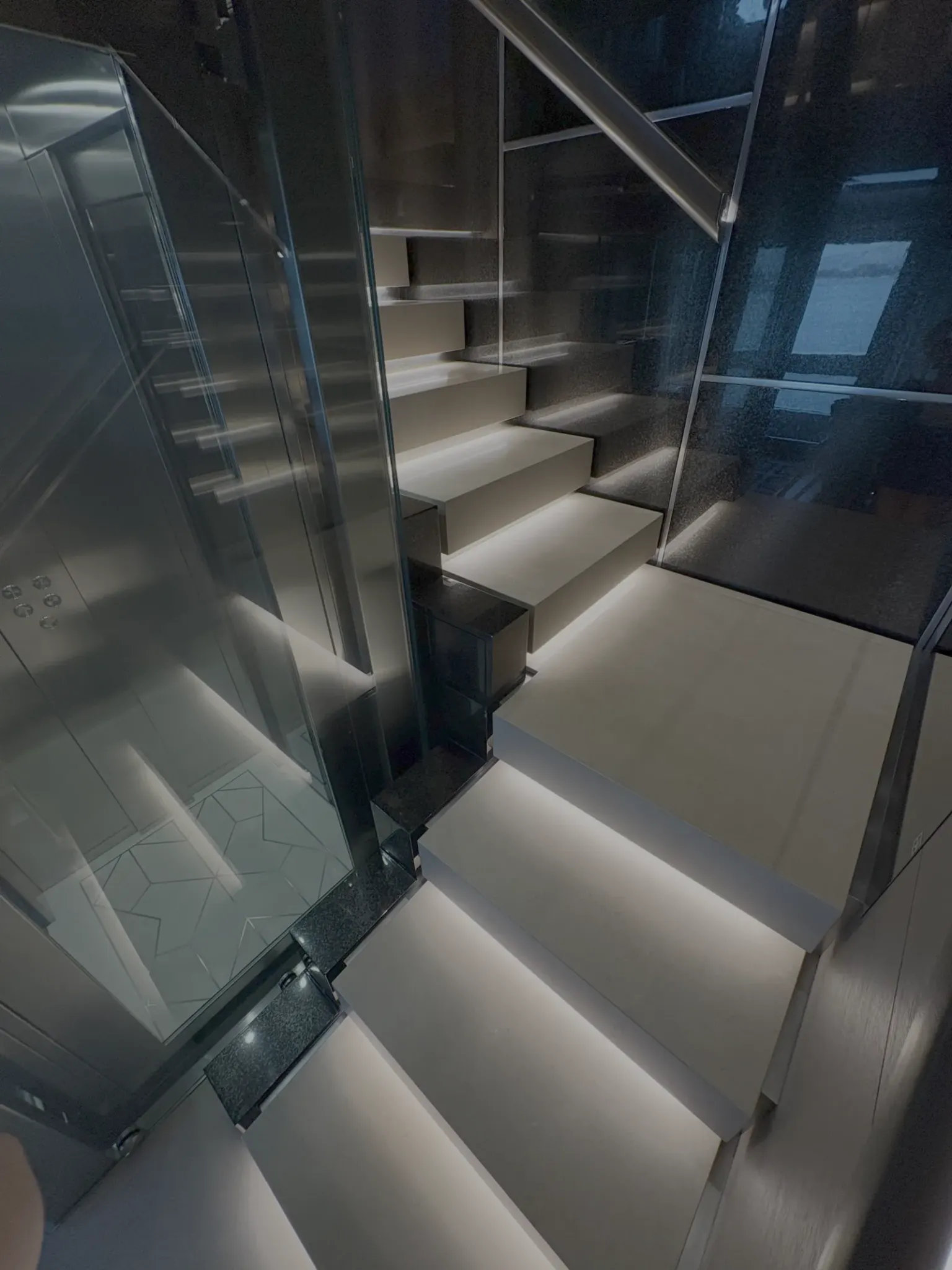
Levelled treads, rebuilt nosings and safe finishes, worked step by step so the stairs stay open throughout.
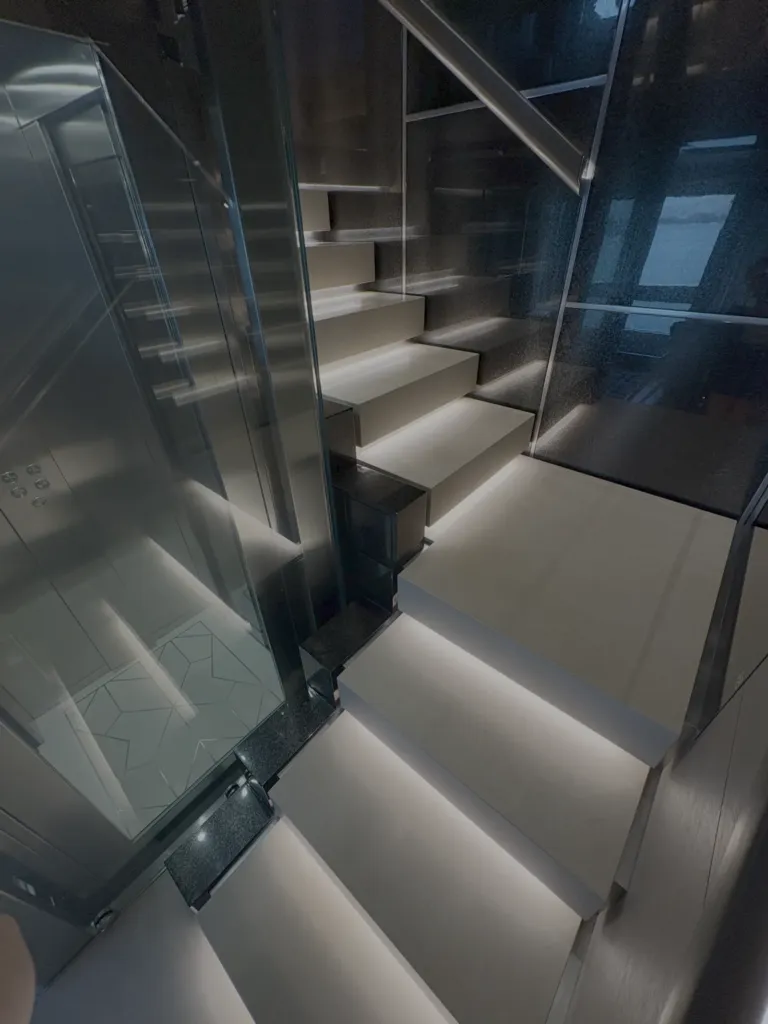
No marble surface wears faster than a staircase. People put their feet in almost exactly the same place every time, in the middle of the tread and close to the edge. After a few decades that spot sinks, turns dull and sometimes becomes slightly hollow, while the sides stay untouched. Marble staircase restoration in Milan means bringing every step back to an even, safe and consistent profile, without taking anything apart.
We work on internal staircases in villas and duplex flats, on the grand stairs of period palazzi and on the communal flights that rise from the entrance hall to each floor. The principle never changes: one step at a time, with lightweight machines and hand tools for the edges, and always a clear way up and down for the people who live there.
A staircase restores well only when each part is treated for the damage it actually has.
The flat part you walk on. It wears in the centre, loses its shine and, in advanced cases, forms a shallow dip where mop water collects.
The front edge of the step, square or rounded. Suitcases, trolleys and heels knock it constantly, so it chips easily.
The vertical face between two treads. Nobody walks on it, yet it is scuffed by shoe tips and stained by dirty water running down.
The marble strings along the sides and the balustrade fixings, where dirt builds up and old wax yellows first.
Milan’s buildings mainly have three kinds of staircase. Solid steps, each cut from a single block, are found on older and grander stairs; they are thick and can take deep grinding. Clad steps are marble slabs a few centimetres thick bonded onto a concrete or brick structure, so the available thickness is limited and every millimetre removed has to be judged carefully.
Cantilevered stairs, with each step built into the stairwell wall on one side only, feature in some nineteenth and early twentieth-century buildings. They look light and elegant, and they call for a gentle approach: no heavy machines, no knocks, and carefully controlled wet work so water does not run into the wall joints. Before starting we always check the stone and look for structural cracks; anything beyond the marble itself is flagged before work begins.
The stone changes with the period too: Carrara and bardiglio on nineteenth-century stairs, Botticino and Ceppo di Gré in many twentieth-century blocks, coloured marbles and granites after the war. Each has its own hardness and needs its own sequence of abrasives.
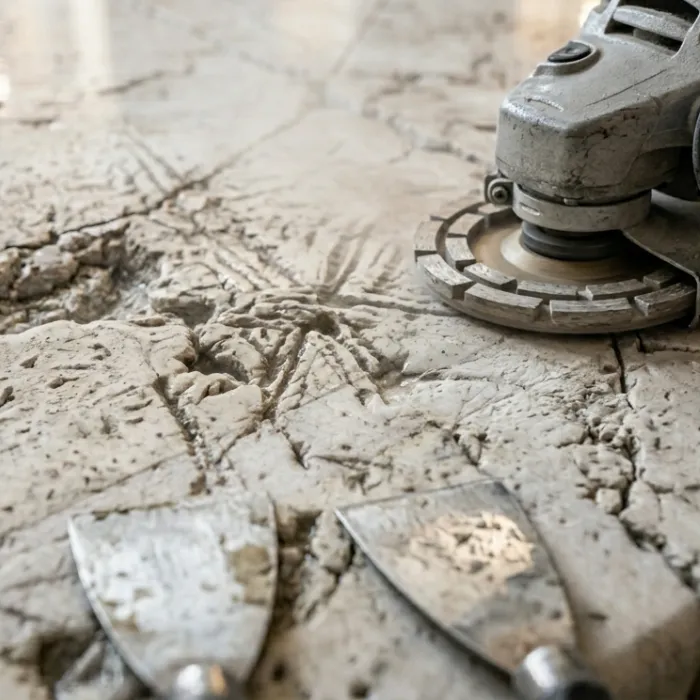
A chipped or missing nosing does not mean replacing the step. We clean the break, mix a structural resin tinted to the marble, shape it with a template that follows the original profile — square, chamfered or bullnosed — and, once cured, grind and polish it together with the tread. The edge becomes continuous again and protects the step from further knocks.
Where the stone has strong veining, fine lines of colour can be painted into the resin before polishing so the repair follows the pattern.
A mirror-polished staircase looks superb, but a sloping route that people often take in a hurry needs grip. On treads we therefore often suggest a honed or satin finish: smooth to the touch, yet the micro-texture left by a medium grit helps soles hold, especially when the stone is damp. Risers, skirting and balustrade bases can still be taken to a full polish, giving a pleasing contrast between the walking surfaces and the decorative ones.
This avoids film-forming anti-slip products, which wear unevenly and yellow over time. The grip comes from the stone itself rather than an added layer.
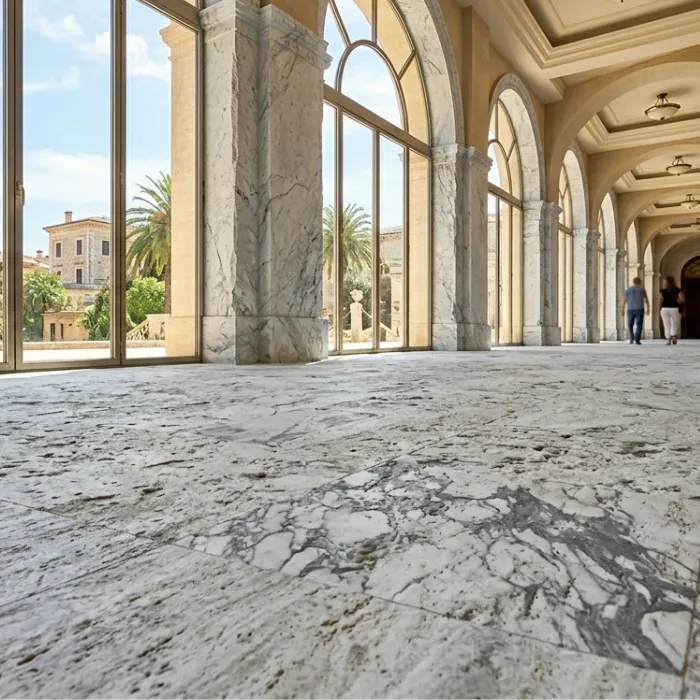
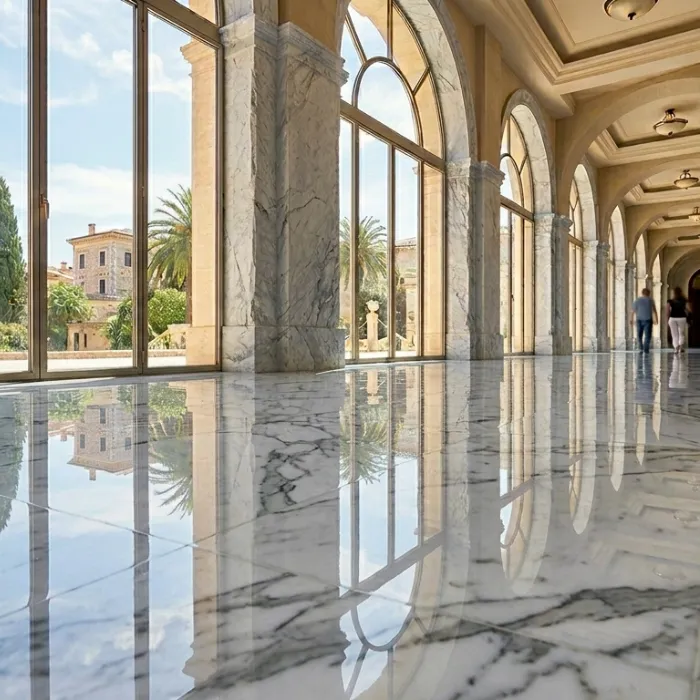
We note the wear, chips and stains on every step to plan the work and estimate timings accurately.
We work on alternate steps or half the width at a time, with signs and tape marking the wet area, so the stairs stay in use.
Nosings and small losses are rebuilt in tinted resin and left to cure before grinding.
Treads are brought back to level, then refined to the agreed finish; risers and skirting are worked with smaller tools.
A breathable sealer limits the uptake of dirt and water without making the surface more slippery.
In most cases, yes, by levelling the tread with coarse grinding. Solid steps have plenty of thickness for this. On clad steps we first work out how much stone can safely come off; if the dip is very deep we reduce it and even out the appearance while keeping the slab sound.
Yes, that is our starting point. We work one step at a time, or half the width on wider stairs, and mark the wet area clearly. Repairs are protected while the resin cures. In an apartment building we agree hours with the building manager and post a notice for residents.
The structural resins we use bond to the stone and stand up to knocks and foot traffic, and they are ground and polished with the marble. Like the original stone, they can chip after a very hard blow; if so, they are repaired locally without redoing the whole step.
For heavily used treads we usually recommend a honed or satin finish: safer and less prone to showing wear. Risers and skirting can be polished. On a staircase inside a home, where people often walk in slippers, a gloss finish on the treads can work well.
The number of steps and landings, how the stairs are built, the depth of wear, the number of nosings to rebuild, the finish and the working conditions, such as hours set by the building’s rules. After the visit you receive a free, itemised written quote.
Send us a WhatsApp message with a few photos — one of the whole flight and some close-ups of the steps — or use the quote request form. We will be back in touch quickly to arrange a visit.
Apartment buildingsThe building lobby, often restored together with the first flight of stairs.
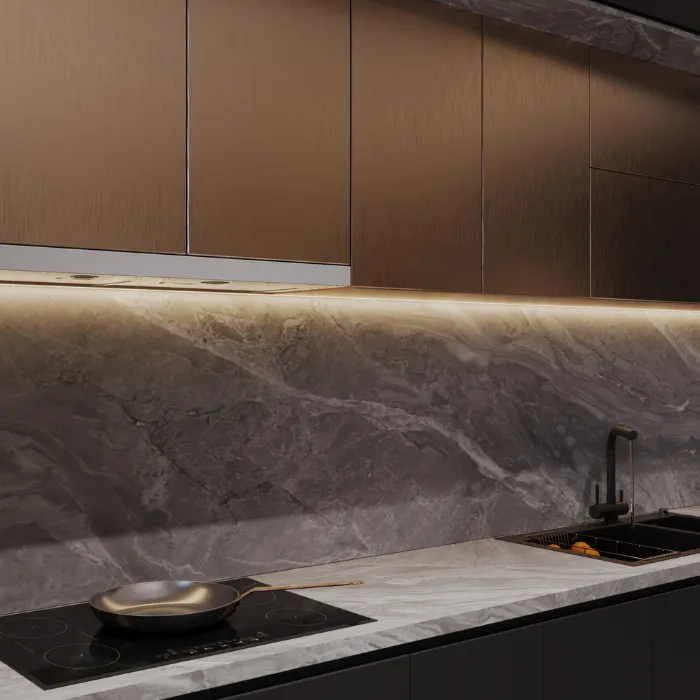 Restoration
Chips, cracks and colour-matched fills on any marble surface.
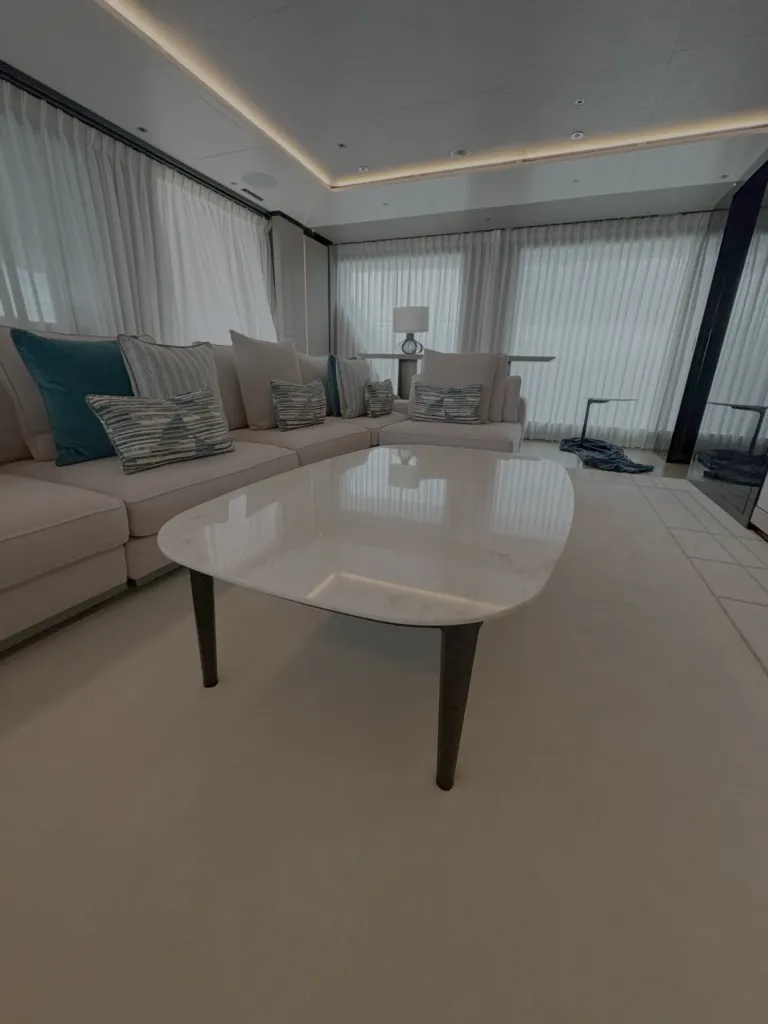 Clients
How we work with building managers: quotes, notices, hours and paperwork.
We work in the city’s historic and residential districts, in Monza and around Lake Como.
Send us a few photos on WhatsApp or fill in the form, and we will arrange a visit and a free quote.