
 Finish
Marble polishing
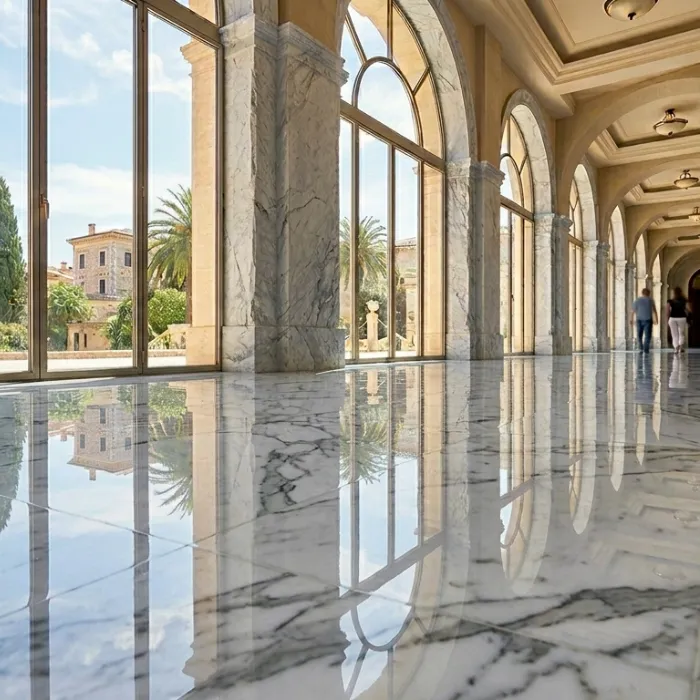
From honed matt to mirror gloss on newly levelled stone.
We level lipped tiles and remove deep scratches and old coatings to give your floor a continuous, even surface again.
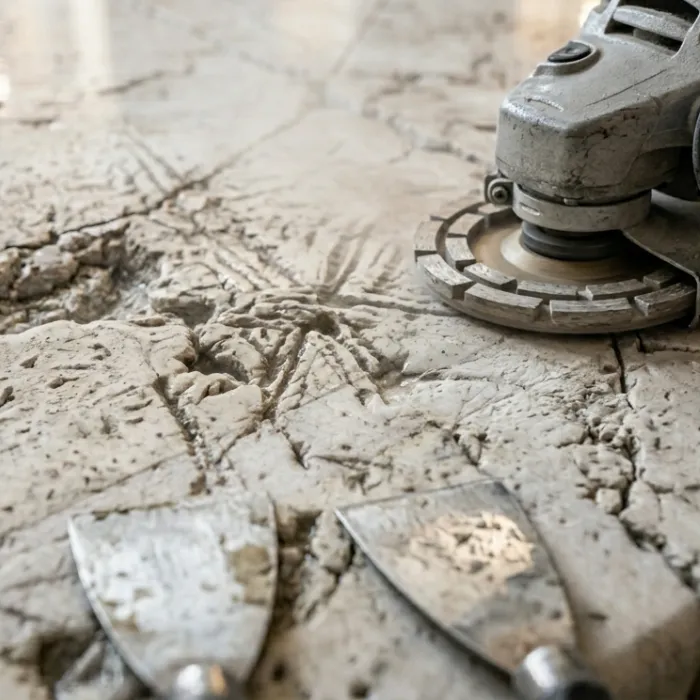
Some floors are beyond the reach of polishing alone. Tiles that stand a millimetre or two proud of their neighbours, deep gouges from a house move, dips eaten out by acid, and years of wax and resin layered one on top of another. That is where marble floor grinding in Milan comes in: it restores a continuous, even surface on which every later treatment can do its job properly.
Grinding means removing a thin, controlled layer of marble with coarse diamond discs on heavy machines, always working wet. Raised edges are taken down until they disappear, deep scratches are erased, and old coatings go along with the damaged stone beneath them.
It is the most demanding stage of marble restoration and the one that transforms a floor the most. Once it is done, rooms tend to look larger and light runs uninterrupted from wall to wall.
Many floors in Milan’s older buildings were laid by hand, tile by tile, on a mortar bed. The effect is beautiful but rarely perfectly flat: slight differences in thickness, a settling screed or later plumbing work are enough to create small steps between tiles. Over the years dirt collects along those edges, which chip and become ever more noticeable.
Modern installations can show the opposite problem: factory-calibrated tiles laid without on-site grinding, with tiny lips that raking light picks out mercilessly. Either way, grinding brings the edges down to a single plane and then evens out the whole surface.
It is also the cleanest way to get rid of old treatments. Waxes, resins and imitation crystallisers come away with the thin skin of stone that held them, without harsh chemical strippers, leaving bare marble ready to be polished and protected.
If any of these sound familiar, polishing on its own will not give an even result.
Grinding is a series of passes with progressively finer abrasives. How many depends on the hardness of the marble and the extent of the damage.
Coarse discs bring down lips and remove wax, resin and deep scratches. This stage takes the most stone and the most time.
With the surface opened up, joints and small voids are filled in a matching colour and ground flush with the stone.
Medium grits erase the coarse marks and make the whole room uniform.
The last grits prepare the stone for its finish: stop at a honed matt or carry on towards gloss.
Marbles do not all behave alike under the disc. Dense Botticino, common in Milanese entrance halls and stairwells, needs longer on each pass than softer white Carrara; veined Bardiglio has to be watched closely because darker and lighter bands can wear at slightly different rates. Terrazzo, found in many twentieth-century apartment buildings, combines marble chips with a cement binder, and grinding has to respect both without hollowing the binder or loosening the chips.
So we choose discs, weights and speeds to suit the stone in front of us, checking progress regularly with a steel straightedge and raking light. The aim is not to remove as much as possible but the least needed for a truly continuous surface.
Wet grinding produces a slurry of marble dust and water. It is what keeps the air free of dust, and it has to be managed properly: we vacuum it up as we go with wet extractors, seal skirting and thresholds with waterproof tape and sheeting, and keep walkways dry. In apartment buildings the residue never goes down shared drains; it is collected, left to settle and disposed of correctly. Getting the machines in is planned too: we measure the lift, check permitted working hours and, in the centre, arrange loading with Area C in mind.
A freshly ground floor is the ideal base for any finish.
FinishFrom honed matt to mirror gloss on newly levelled stone.
 Durability
For heavily used calcareous floors, once polished.
 Surfaces
How we approach large living rooms, corridors and halls.
No. We remove only what is needed to clear lips and scratches, usually a fraction of a millimetre, a little more where tiles stand proud. A marble floor of normal thickness can be ground several times over its lifetime without any issue, and the initial survey is there precisely to judge how much needs to come off.
Hardly at all, because we work wet. Instead of dust there is slurry, which we vacuum up during the job and dispose of properly. Walls and skirting are shielded from splashes and walkways are kept dry, so the rooms we are not working in remain perfectly usable.
Yes, and it is often a good idea, since even calibrated tiles show small lips once laid. The screed and adhesive must have fully cured first; the waiting time depends on the materials and we agree it with the contractor or site manager.
It depends on the area, the hardness of the marble, how uneven the tiles are and how many rooms need clearing. The quote gives a realistic duration and the order in which rooms will be treated, so you can plan ahead.
Floor area, the depth of lips and scratches, any wax or resin, the number of joints to refill, the final finish and site access all play a part. After the visit you receive a free written quote with each item listed separately.
Send us a few photos on WhatsApp, including one taken at a low angle so the lips show up, or fill in the quote request form. We will be in touch quickly to arrange a visit.
Show us with a few photos on WhatsApp or through the form. We will come and measure, then send you a free quote.